Insulating steel with rigid boards is difficult. Steelwork, cladding and metal roofs have complex profiles, and boards require battening, mechanical fixings and cutting around details — all of which introduce thermal bridges, cavities and access issues. In plant rooms and congested steel structures, boards are often simply impractical.
A spray-applied natural cork thermal coating adheres directly to the steel surface, forming a continuous thermal layer that follows the profile of the steel — no battens, no boards, no fixings and no cavities. This makes it particularly suitable for steel substrates where rigid insulation is impractical.
By improving the thermal behaviour of the cold steel surface, an appropriate VIPEQ cork-enhanced thermal coating can help raise its surface temperature and reduce the conditions that lead to condensation — directly on the steel, without the complexity of board systems.
The Principle: Surface Temperature & Dew Point
Condensation forms when warm, moisture-laden air meets a surface whose temperature has fallen below the dew point. By improving the thermal behaviour of a cold surface, an appropriate thermal coating can help raise its internal surface temperature and reduce the conditions that lead to surface condensation.
Humidity
Surface Temp
Dew Point
Key Takeaways
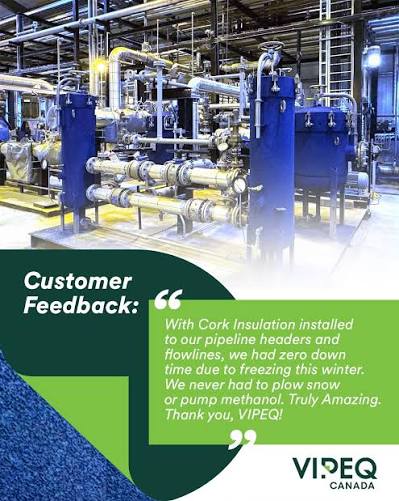
Customer Feedback:
With Cork Insulation installed to our pipeline headers and flowlines, we had zero down time due to freezing this winter. We never had to plow snow or pump methanol. Truly Amazing. Thank you, VIPEQ!
VIPEQ
Ireland
Have a Condensation, Cold-Surface or Thermal-Bridging Problem?
Send us photographs, drawings or details of the substrate and application and we can assess whether a VIPEQ system is suitable for your project.