
Heritage & Traditional Buildings — Breathable Thermal Coating
Breathable Thermal Coating for Heritage Buildings Ireland
Vapour-permeable thermal coating for solid stone walls, lime walls and historic buildings. By raising surface temperature while allowing the building to breathe, an appropriate VIPEQ thermal coating helps control condensation in traditional buildings.
Condensation & Thermal Bridging in Traditional Buildings
Heritage and traditional buildings — solid stone walls, lime-rendered facades, historic masonry — behave very differently from modern cavity-walled construction. Solid walls have no cavity to break the thermal path, so heat flows directly through the masonry, creating cold internal surfaces that fall below the dew point and condense moisture.
Trapping moisture in traditional buildings is one of the greatest risks of retrofit. Impermeable insulation and modern membranes prevent the building from breathing, driving moisture into the masonry and causing damp, decay and freeze-thaw damage. Any thermal treatment for a heritage building must be vapour-permeable.
A breathable thermal coating applied to the internal face of a solid wall raises its surface temperature and reduces condensation, while remaining vapour-permeable so the masonry can continue to breathe — the same principle that makes lime render suitable for traditional buildings. This links directly to VIPEQ cork-enhanced systems, which are naturally vapour-permeable.
Why Breathability Matters in Heritage
Traditional buildings were designed to breathe. Any thermal treatment must be vapour-permeable — otherwise moisture is driven into the masonry, causing the damp and decay that ruin historic fabric. A breathable thermal coating raises surface temperature without trapping moisture.
Surface Temperature, Dew Point & Condensation
Condensation forms when warm, moisture-laden air meets a surface whose temperature has fallen below the dew point. By improving the thermal behaviour of a cold surface, an appropriate thermal coating can help raise the internal surface temperature and reduce the conditions that lead to surface condensation.
Humidity
Surface Temp
Dew Point
Key Benefits
Where Breathable Thermal Treatment Applies
Solid Stone Walls
Internal thermal coating to raise surface temperature and control condensation on solid stone wall faces.
Lime-Rendered Walls
Compatible breathable thermal treatment for lime-rendered traditional buildings.
Historic Buildings
Vapour-permeable thermal coating for listed and historic structures where moisture must not be trapped.
Old Buildings with Damp
Surface temperature improvement for older buildings suffering cold-surface condensation and pattern staining.
Thermal Bridges in Masonry
Treatment of lintels, junctions and masonry details that act as thermal bridges in traditional construction.
Listed Building Retrofit
Thin-film, breathable thermal improvement suitable for sensitive heritage retrofit projects.
A Natural Cork Thermal Coating — Not a Paint
VIPEQ's cork-enhanced thermal coating systems are spray- or trowel-applied directly to the substrate, forming a thin, flexible, vapour-permeable thermal layer that conforms to irregular surfaces — steel, concrete, masonry and timber — without rigid boards, battens or significant loss of internal space.
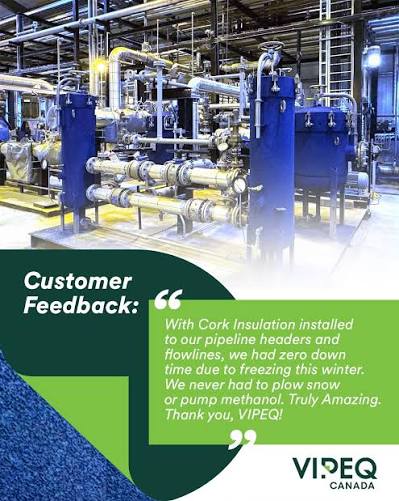
Customer Feedback:
With Cork Insulation installed to our pipeline headers and flowlines, we had zero down time due to freezing this winter. We never had to plow snow or pump methanol. Truly Amazing. Thank you, VIPEQ!
VIPEQ
Ireland
Frequently Asked Questions
Related Solutions
Not sure which system applies?
Send us photographs, drawings or details of the substrate and application and we can assess whether a VIPEQ system is suitable — free, no obligation.
Have a Condensation, Cold-Surface or Thermal-Bridging Problem?
Send us photographs, drawings or details of the substrate and application and we can assess whether a VIPEQ system is suitable for your project.