
Food & Beverage Manufacturing — Condensation Control
Food Factory Condensation Control Ireland
Spray-applied natural cork thermal barrier for food processing plants, dairies, meat plants, bakeries and beverage facilities. By raising the surface temperature of cold roofs and walls above the dew point, an appropriate VIPEQ thermal coating helps stop condensation dripping onto production areas.
Condensation in Food & Beverage Manufacturing
Food and beverage manufacturing creates high-humidity environments — cooking, washing, pasteurisation and cleaning all release moisture into the air. When that warm, moist air meets a cold roof, ceiling or wall surface, it condenses if the surface temperature has fallen below the dew point.
Condensation dripping from factory roofs and ceilings is a serious problem in food production: it can contaminate product, create slip hazards, promote mould and bacterial growth, and fail hygiene audits. Dairy processing, meat processing, bakery and beverage plants are all particularly vulnerable.
A spray-applied natural cork thermal barrier applied directly to the cold roof or wall surface raises its internal surface temperature, reducing the conditions that lead to condensation. Unlike rigid boards, it conforms to existing roof profiles and does not introduce joints or cavities that could harbour contamination.
Important — Technical Suitability
Any VIPEQ system proposed for a food production environment must be confirmed as technically suitable for the specific area, substrate and hygiene context. Contact us with details of your facility and we can advise on suitability.
Surface Temperature, Dew Point & Condensation
Condensation forms when warm, moisture-laden air meets a surface whose temperature has fallen below the dew point. By improving the thermal behaviour of a cold surface, an appropriate thermal coating can help raise the internal surface temperature and reduce the conditions that lead to surface condensation.
Humidity
Surface Temp
Dew Point
Key Benefits
Where Condensation Control Is Needed
Dairy Processing Plants
High humidity from washing and pasteurisation condenses on cold ceilings and walls — thermal treatment raises surface temperature to reduce dripping.
Meat Processing Plants
Condensation control on cold surfaces in processing halls, chill rooms and packing areas to protect product and hygiene standards.
Bakery Production
Oven steam and washing cycles raise humidity — cold roof surfaces condense moisture that can drip onto product and equipment.
Beverage Plants
Bottling, washing and CIP processes create humid conditions that condense on cold steelwork, ceilings and walls.
Food Storage Buildings
Condensation control in storage and dispatch areas protecting finished goods and packaging from moisture.
Factory Ceilings & Roofs
Direct anti-condensation treatment for the cold underside of metal and concrete factory roofs.
A Natural Cork Thermal Coating — Not a Paint
VIPEQ's cork-enhanced thermal coating systems are spray- or trowel-applied directly to the substrate, forming a thin, flexible, vapour-permeable thermal layer that conforms to irregular surfaces — steel, concrete, masonry and timber — without rigid boards, battens or significant loss of internal space.
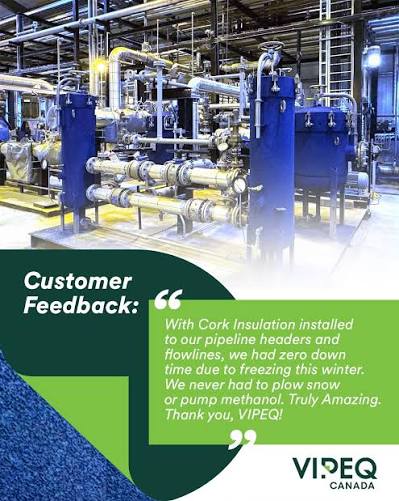
Customer Feedback:
With Cork Insulation installed to our pipeline headers and flowlines, we had zero down time due to freezing this winter. We never had to plow snow or pump methanol. Truly Amazing. Thank you, VIPEQ!
VIPEQ
Ireland
Frequently Asked Questions
Related Solutions
Not sure which system applies?
Send us photographs, drawings or details of the substrate and application and we can assess whether a VIPEQ system is suitable — free, no obligation.
Have a Condensation, Cold-Surface or Thermal-Bridging Problem?
Send us photographs, drawings or details of the substrate and application and we can assess whether a VIPEQ system is suitable for your project.